
Five AI traders walk into a meeting room
Instead of one algorithm, five AI agents with distinct personalities and philosophies debate in real time to reach a trading decision — and the user can watch every step of that debate.
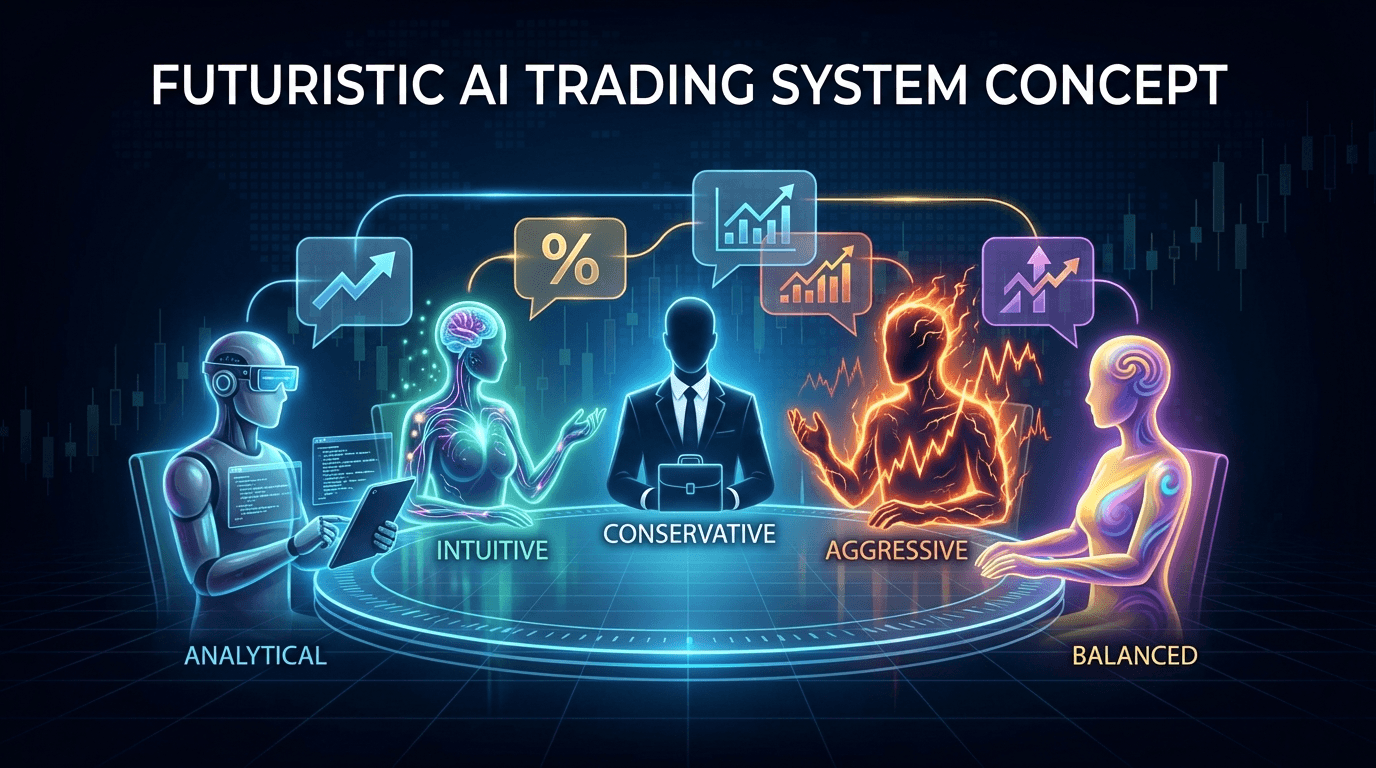
Strategies decide first, the committee reviews — the design principle behind a new kind of trading bot.
What is your trading bot doing right now? Most of them buy when a condition is met and sell when another one is. Nobody knows why it bought, or why it sold. Open the logs and you get numbers and timestamps; almost no program explains the "why" in language a human can read.
We solved this with two layers. The first layer is strategy. The trading strategies a user has picked each analyse the market by their own criteria and reach an independent verdict. The second layer is the committee: five AI agents with different temperaments and investment philosophies add their perspective to what the first layer decided. Strategies decide what to do; the committee reviews that decision from multiple angles.
The black box era is over
The fundamental problem with existing trading systems is a lack of trust. The program bought bitcoin with my money at 3am. Why? "RSI was below 30." That's it. Fine, RSI was below 30 — but what was the volume? Where was price relative to the Bollinger bands? What did the other strategies think about the same asset? Nobody tells you.
Our system is different. Which strategy fired the signal, how the vote split when multiple strategies were active, how the committee reacted to that signal, and on what grounds the buy was ultimately executed — all of it is recorded in natural language and stored so the user can open it up at any time.
Layer 1: strategies decide first
The first layer is the strategy engine. Users pick and activate whichever of our eleven strategies suit them.
The range is broad. There are classics that combine technical indicators, like the RSI+MACD composite. There are price-structure strategies: volatility breakout, MA20 pullback, MA alignment, VCP pattern, cup-and-handle. Some are sell-only by design, like the trailing stop strategy. Others read signals from outside the market, like AI news sentiment analysis. And then there is the AI committee strategy — more on that below.
Each strategy has two key settings. Capital allocation (capital_pct) determines what percentage of a single trade's budget is used when a buy signal fires. Role (signal_type) sets whether the strategy watches buy signals only, sell signals only, or both. Set the volatility breakout strategy to buy-only with capital_pct at 80%, and every buy signal it produces deploys 80% of the per-trade budget.
Multiple strategies can be active at once. Each runs independently and produces its own signal. If strategies calling for a buy make up 40% or more of all active strategies, the buy goes through. Below that threshold, the system waits. No single strategy can dominate the outcome on its own.
Layer 2: five AIs build a signal by consensus
The second layer is the AI committee strategy. It is one of the eleven strategies, and users choose whether to activate it. The difference is that its signal comes not from a single algorithm but from five AI agents in debate.
Oracle 📊 is the technical analyst. It examines RSI, MACD, Bollinger bands and volume ratios and reports without bias. Rather than arguing hard for a direction, it states objectively what condition the market is in.
Marcus 🐂 is the team's bull. Working from the belief that markets rise over the long run, he looks for the bullish reading of the same data. He is sensitive to positives like oversold conditions and golden crosses, and is excellent at spotting entries.
Cassandra 🐻 is the bear. Her principle is that whoever survives, wins, so she focuses on downside risk and warning signs. Where Marcus sees an opportunity, Cassandra suspects a trap. Her pessimism sometimes costs the team an entry, but in a falling market she is the first to sound the alarm.
Sentinel 🛡️ is the risk manager, indifferent to market direction. It checks whether RSI sits at an extreme (below 20 or above 80), whether price is pressed against a Bollinger band, whether volume looks anomalous — and judges whether this is a sensible moment to enter. When uncertain, it recommends waiting.
Finally there is Sage 🧘. As chair and mediator, Sage takes all four opinions and makes the call. If three or more of the four agree on a direction, that direction wins. When the vote is evenly split, risk principles take priority and Cassandra's and Sentinel's views carry more weight. When conviction is lacking, Sage waits. That decision becomes one strategy signal, and joins the layer-one vote.
The four committee members run their analysis in parallel on the Gemini 2.5-flash API. They don't just stamp "buy" or "sell": each submits a one-sentence rationale and a confidence score from 0 to 100. Sage reads all of it before deciding.
How the two layers work together
Here is a run through the actual sequence.
Say a user has activated the RSI+MACD composite strategy, the volatility breakout strategy and the AI committee strategy.
The bot wakes every 60 seconds and begins its analysis. All three strategies run at once. RSI+MACD returns "buy — oversold RSI plus MACD golden cross". Volatility breakout answers "hold — breakout conditions not met". Inside the AI committee strategy, Oracle, Marcus, Cassandra and Sentinel start analysing in parallel. Marcus submits "buy — expecting a bounce from oversold". Cassandra submits "hold — need confirmation of a trend reversal". Sentinel submits "hold — RSI at an extreme, watch volatility". Sage weighs all four and decides "hold — waiting, on risk-first principle". That becomes the third strategy's vote.
Result: one buy, two holds. Buy share 33%. Below the 40% threshold. The system ends this cycle without acting.
On the next cycle price drifts lower and RSI hits 29. This time Marcus submits a strong buy at confidence 88, and Sentinel switches to "entry permitted at 50% size". The committee strategy returns "buy". Two of the three strategies — RSI+MACD and the committee — are now buying. 67% consensus. The system executes. And the whole sequence is stored alongside the trade record.
When risk appears, the committee wakes first
The committee does more than generate signals. The system tracks open positions' P&L in real time, and the moment a position drifts toward the stop-loss line (-3%) it convenes the committee automatically.
This is not yet a situation that requires cutting the position. But it is not one to be relaxed about either. At this point a rule-based committee engine analyses the situation from all five agents' perspectives, using current RSI and MACD, and writes up the debate. Marcus argues for a bounce; Cassandra warns of further downside; Sentinel insists on respecting the stop line. The discussion is recorded live in the "committee floor" view.
The user reads that debate and decides for themselves: keep the bot running, close out manually, or adjust the stop. The bot is not handling it on the user's behalf — the user now has enough information to make the call. Crucially, a committee debate at this stage does not force a sell. The decision remains the user's.
Why this is better
The fundamental limitation of conventional trading bots is a single point of view. One strategy, one algorithm, one set of criteria. When the market matches those criteria it works well; when it doesn't, there is nothing to fall back on.
Our system guarantees multiple perspectives structurally. Technical strategies read the market by their own rules, and the AI committee strategy adds genuine multi-angle analysis as one more vote. Combining votes filters out any single strategy's misjudgement. And when risk appears, the committee raises the alarm first.
The user sees all of it: which strategy fired, how the vote split, what each of the five committee members thought. Click a trade record and the full deliberation behind that decision unfolds. That transparency is what builds trust — and trust is what makes it possible to run a trading system without losing sleep.
The architecture, briefly
Strategy execution and committee debate run as fully separate layers. The strategy engine judges purely technical conditions; the committee inside the ai_committee strategy analyses in the language of AI through the Gemini API. Adding a new strategy or adjusting an agent's personality affects neither the other.
Because the four committee members analyse in parallel, response time is far shorter than sequential processing would allow. Every member's analysis, Sage's final decision and every dissenting opinion are persisted to the database. A user can pull up the reasoning behind a buy made six months ago.
Signal generation, committee debate and trade execution are all asynchronous. A slow strategy or API call never blocks another strategy from running. If the Gemini API times out inside the ai_committee strategy, that strategy alone returns hold and the remaining votes proceed normally.
The future we're building toward
This is not just a trading bot. It is the beginning of a paradigm in which AI simulates the human process of investment decision-making.
At a real investment firm, several analysts analyse from different angles, quantitative models generate signals, a risk manager imposes limits, and a CIO makes the final call. We reproduced that structure in software. Retail investors can now have an institutional-grade decision process.
Next we can track each strategy's and each member's historical hit rate and adjust voting weights dynamically, add a macroeconomic specialist agent, or introduce sector-specialist members. The system's modular structure makes that kind of extension natural.
A system where every "why" behind a trade is recorded. Strategies voting democratically, an AI committee adding multiple perspectives, and warnings that sound before the risk arrives. Plus a user experience that lets you watch it all happen. That is the trading system we built, and the future of automated trading we believe in.