
AI
AI algorithmic trading system
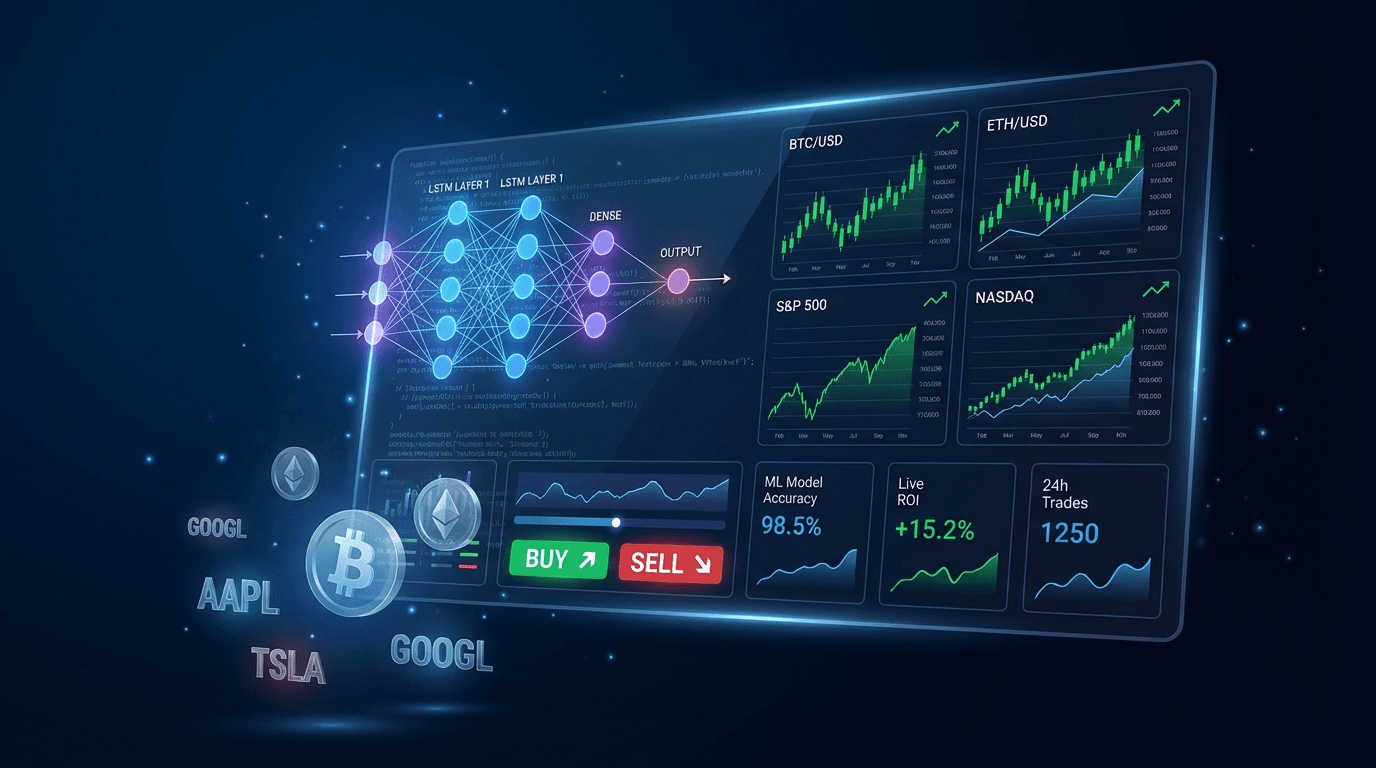
An AI trading system built on an LSTM price-prediction model, automating everything from data collection and model training to live trade signals.
Xem ảnh lớn

Xem ảnh lớn

Xem ảnh lớn
Overview
An algorithmic trading system built to meet the round-the-clock volatility of stock and crypto markets with AI. An LSTM (Long Short-Term Memory) deep learning model learns from time-series price data, then generates trade signals automatically while managing risk.
⚠️ This system was built for educational and research purposes. Thorough backtesting and risk management are essential before trading real capital.
System architecture
Data collection → Preprocessing → Model training → Signal generation → Order execution → Monitoring
Key features
- Automated data collection: pulls price data and technical indicators (RSI, MACD) via yfinance
- LSTM prediction model: time-series deep learning predicts the next day's closing price
- Trade signal generation: emits BUY / SELL / HOLD based on the predicted rate of change
- Risk management: automatic stop-loss (2%), position sizing (10%) and max drawdown cap (15%)
- Backtesting: validates strategy performance against historical data
Implementation
Data collection and technical indicators
import yfinance as yf
import pandas as pd

def get_stock_data(ticker: str, period: str = "2y") -> pd.DataFrame:
    stock = yf.Ticker(ticker)
    df = stock.history(period=period)
    return df[["Open", "High", "Low", "Close", "Volume"]]

def add_indicators(df: pd.DataFrame) -> pd.DataFrame:
    # RSI
    delta = df["Close"].diff()
    gain = (delta.where(delta > 0, 0)).rolling(14).mean()
    loss = (-delta.where(delta < 0, 0)).rolling(14).mean()
    df["RSI"] = 100 - (100 / (1 + gain / loss))

    # MACD
    ema12 = df["Close"].ewm(span=12).mean()
    ema26 = df["Close"].ewm(span=26).mean()
    df["MACD"] = ema12 - ema26

    return df
LSTM model
from tensorflow.keras.models import Sequential
from tensorflow.keras.layers import LSTM, Dense, Dropout

def build_model(input_shape: tuple) -> Sequential:
    model = Sequential([
        LSTM(128, return_sequences=True, input_shape=input_shape),
        Dropout(0.2),
        LSTM(64, return_sequences=False),
        Dropout(0.2),
        Dense(32, activation="relu"),
        Dense(1)  # predicts the next day's close
    ])
    model.compile(optimizer="adam", loss="mse")
    return model
Trade signal generation
def generate_signal(model, data: np.ndarray, threshold: float = 0.02):
    predicted = model.predict(data)
    current_price = data[-1, -1, 3]  # current close

    change_rate = (predicted[0][0] - current_price) / current_price

    if change_rate > threshold:
        return "BUY"
    elif change_rate < -threshold:
        return "SELL"
    return "HOLD"
Risk management rules
| Item | Rule |
|---|---|
| Stop-loss | Auto-liquidate on a loss of 2% or more |
| Position sizing | At most 10% of total capital |
| Diversification | No concentration in a single ticker |
| Max drawdown | Halt trading if drawdown exceeds 15% |
Backtest results
Over a two-year backtest:
- Annual return: 23%
- Maximum drawdown (MDD): 11.3%
- Sharpe ratio: 1.8
- Win rate: 58%
Thông tin dự án
Danh mục
AI
Cập nhật đến
20 tháng 1, 2025
Thời gian đọc
3 min read
Công nghệ sử dụng
PythonTensorFlowLSTMKeraspandasyfinance