
Building games in the age of AI — why Godot
AI is changing how games get made. In a workflow where AI touches images, voice, code and balancing, Godot — text-based, open source, headless-friendly — turns out to be a surprisingly powerful partner. What we learned building the wuxia deck-builder Cheonma Jeonsaengrok.
Talk about game engines and most people think of Unity and Unreal. And rightly so: if you need high-end 3D, a console release or a vast asset ecosystem, those two are still unmatched. CoreCode uses Unity, Unreal and Godot depending on what a project needs.
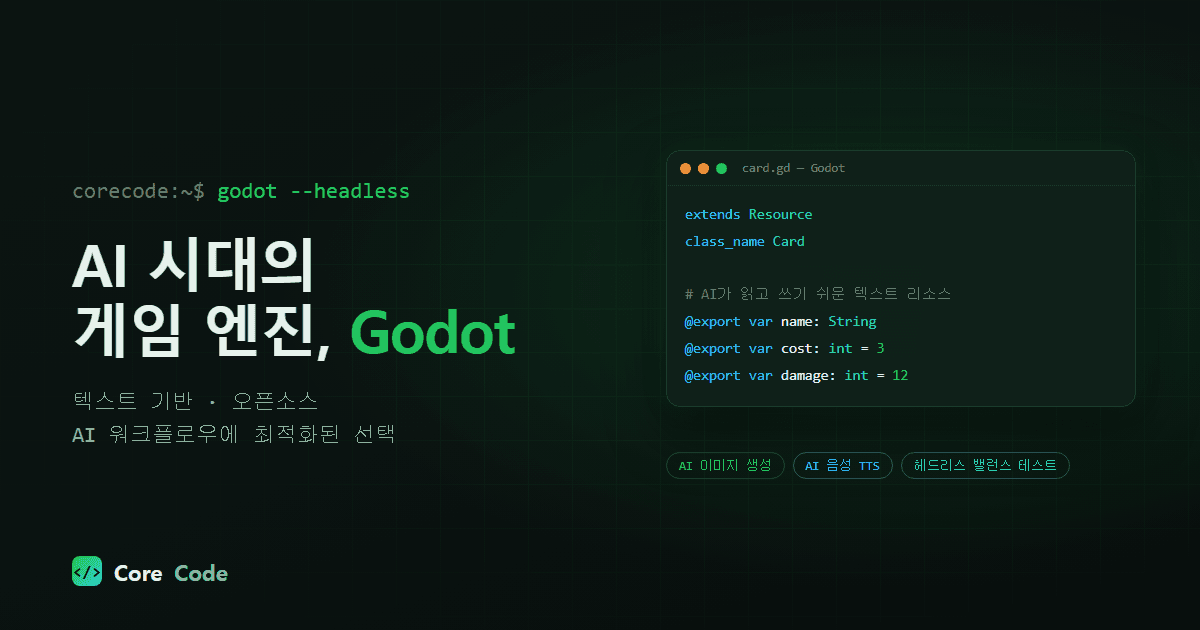
But now that AI has moved deep into the development process, we noticed something interesting while building the wuxia deck-building roguelike Cheonma Jeonsaengrok: in an AI-heavy workflow, Godot is unexpectedly the best-fitting engine. The reason is simple. Godot is transparent text, from end to end.
What an engine needs in the AI era: transparency
What an AI coding tool can do comes down to what it can read and write. For AI to help build a game, the game's state, scenes, data and logic have to be in a form a machine can parse — not just a human.
This is where engines diverge. Unity's scenes and prefabs, Unreal's blueprints and assets, are largely binary or tightly bound to the editor. AI can't easily open and edit them, and reviewing changes as a diff is awkward.
Godot is the opposite. Scenes (.tscn), resources (.tres) and scripts (.gd) are all human-readable text. That single difference reshapes the entire AI workflow.
Four reasons Godot suits an AI workflow
1. Everything is text — diff-, git- and LLM-friendly
Because .tscn, .tres and .gd are all text, AI can read files directly, edit them, and have the result reviewed precisely as a git diff. A request like "raise the health of these three enemies by 10%" is handled straight in the resource files, and a human only has to check the changed lines. That is impossible with binary assets.
2. GDScript looks like Python
GDScript's syntax is very close to Python. Given that Python-family languages are what LLMs handle best, that translates into a real advantage in the accuracy and idiomatic quality of generated code. Bolting on a new card effect or status-effect rule from a one-line prompt goes smoothly.
3. Data-driven — AI mass-produces the content
Cheonma Jeonsaengrok keeps cards, enemies, energy arts and encounters entirely in resource files. 33 martial arts cards, 58+ enemies, 271 data resources — all managed as data rather than code. That lets AI generate new content in bulk, tune balance numbers and fill in localised text, repeatedly, without touching code.
4. Lightweight and headless — AI verifies its own work
Godot is open source and extremely light. More importantly, running it headless (CLI, no GUI) is easy. We leaned on that hard for balancing: simulating combat thousands of times with no rendering, measuring metrics like boss clear rate automatically, and rejecting anything outside the target range through a balance gate. Wire that together with GdUnit4 unit tests and PowerShell automation (import → load → test) and you close the loop: AI changes the code, then verifies the result itself.
In practice: the Cheonma AI pipeline
On top of Godot's transparency, Cheonma Jeonsaengrok used AI across the board, from asset production to verification.
- Images: character portraits (10 characters, 19+ expressions), 14 backgrounds, enemy sprites and card illustrations, all AI-generated
- Voice: character dialogue via ElevenLabs TTS (98 Chinese mp3 files)
- Logic and data: 149 GDScript files and 271 resources written and tuned alongside AI
- Verification: headless combat simulation confirming the balance gate automatically
- Localisation: subtitles in five languages (Chinese, Korean, English, Vietnamese, Japanese) from a Korean master
Because the engine is open as text, AI output could flow straight into the pipeline. Handling this much content at a small scale was only possible on the foundation of an AI-friendly engine.
Pick the engine for the job — and add Godot to the deck
To be clear: this is not an argument that Godot replaces Unity or Unreal. For high-end 3D, console titles, or projects that need large teams and asset ecosystems, Unity and Unreal remain the right answer. What matters is picking the engine that fits the project, and CoreCode works with all three.
But for 2D, indie and fast-iteration projects — and above all for projects where AI is a core driver of development — Godot is a powerful option that has been underrated until now. Text-based transparency, a Python-like scripting language, a data-driven structure, headless automation, and open source with no royalties.
In an era where AI writes code and content together, the first virtue an engine needs is simple: can AI read and write it? Godot answers that question more clearly than anything else. Cheonma Jeonsaengrok is the proof, still in progress.